
PC CF Filament: Is It Worth It? Strength Tests, Real Use Cases, and Print Settings
Introduction
The world of 3D printing is constantly evolving, and the materials available today are far more advanced than the PLA and ABS of a few years ago. Among these advanced materials is PC CF filament, Short for Polycarbonate Carbon Fiber Reinforced filament. This specialized composite promises durability, stiffness, and performance that is far beyond typical filaments, but is it worth the hype? In this article, we’ll explore:
- What PC CF filament is
- Its mechanical properties and strength test results
- Where it truly shines (and where it doesn’t)
- Real-world use cases
- How to print it (settings, hardware requirements, best practices)
- Pros, cons, and value proposition
What is PC CF Filament?
PC CF filament is essentially Polycarbonate infused with chopped carbon fibers. The carbon fibers aren’t long strands, but short particles that are mixed into the base polymer. The result? A filament that aims to combine the heat resistance and toughness of polycarbonate with the rigidity and dimensional stability of carbon fiber.
Key Characteristics
- Higher stiffness (modulus) than standard filaments
- Better strength-to-weight ratio
- Less warping compared to pure polycarbonate
- Improved heat resistance
- Matte, industrial finish
The chopped fibers act as a reinforcing agent, making printed parts stronger in many scenarios, but also a bit more challenging to print.

So… Is It Actually Strong?
Yes, but with challenge in printing process.
| Property | PC CF Filament | Standard PLA | ABS | Pure PC |
|---|---|---|---|---|
| Toughness | High | Medium | Medium | Very High |
| Stiffness | Very High | Low | Medium | High |
| Heat Resistance | High | Low | Medium | High |
| Impact Resistance | Moderate | Medium | Medium | High |
| Print Difficulty | Hard | Easy | Medium | Hard |
Verdict: PC CF is mechanically superior to typical hobbyist filaments, but doesn’t replace high-end engineering materials like PEEK or Ultem, it sits in the middle.
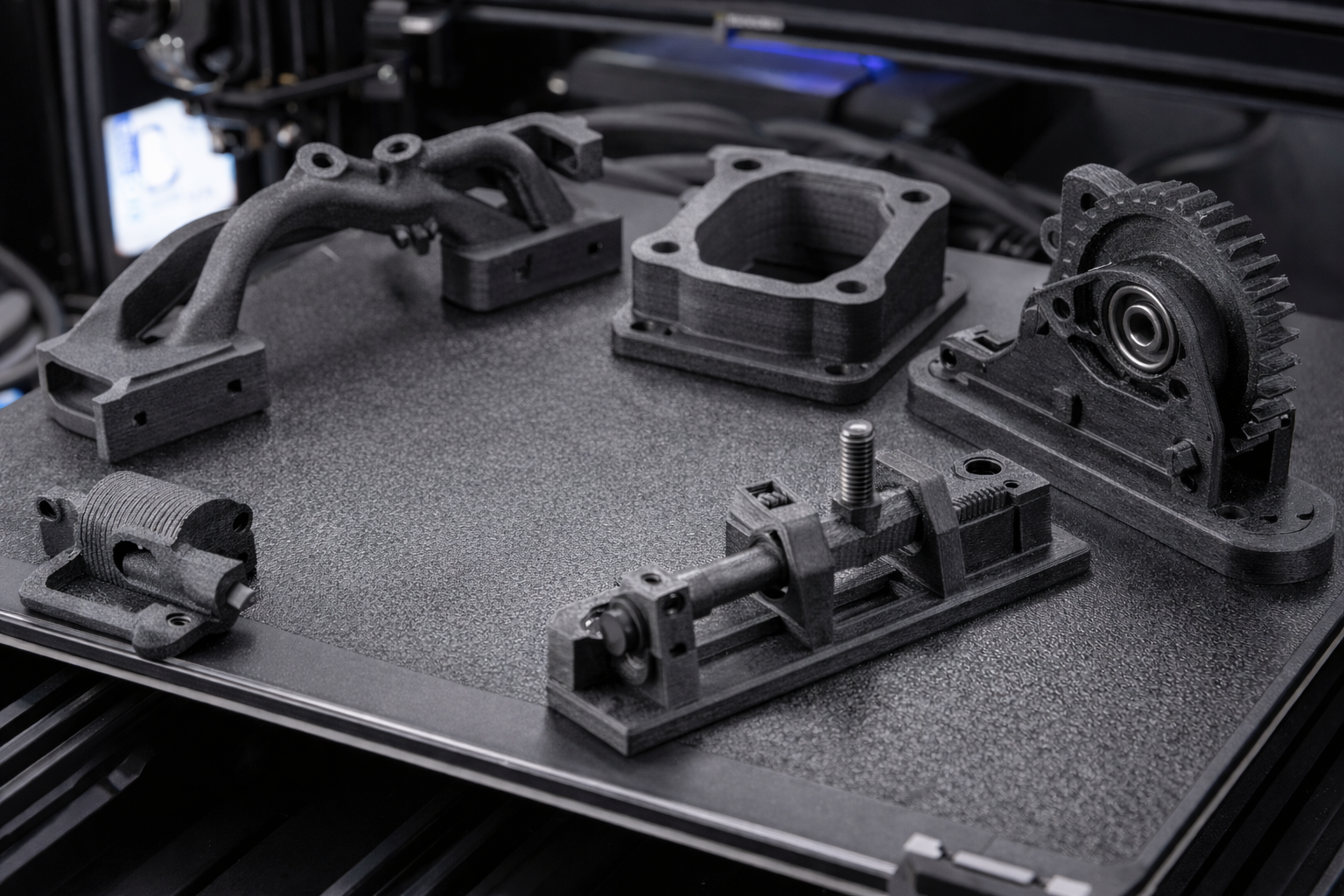
Real Use Cases: Where PC CF Shines
PC CF is not for every print. It shines where performance matters:
1. Functional Mechanical Parts
- Structural brackets
- Mounts & fixtures
- Robotics parts
- Load-bearing connectors
2. Automotive Components
Because of heat resistance and stiffness, PC CF is excellent for interior components and under-the-hood non-critical parts.
Examples:
- Retainers
- Duct mounts
- Sensor housings
3. Jigs & Production Tools
Short-run manufacturing often uses 3D printed jigs. PC CF is a good choice when steel or aluminum is too expensive.
4. Consumer Electronics Housings
When a premium feel and durable housing are needed, PC CF’s matte look and stiffness are desirable.
Where It’s Not Ideal
PC CF has limitations:
- Not for impact-prone parts
- Not for flexible or elastic designs
- Not a replacement for engineering-grade thermoplastics in high-performance fields like aerospace
And it’s not the best choice if your goal is easy printing, more on that below.
Print Settings: Getting It Right
Printing PC CF isn’t plug-and-play. Here’s what you need to know.
1. Printer Requirements
Hotend:
- Capable of 260–300 °C
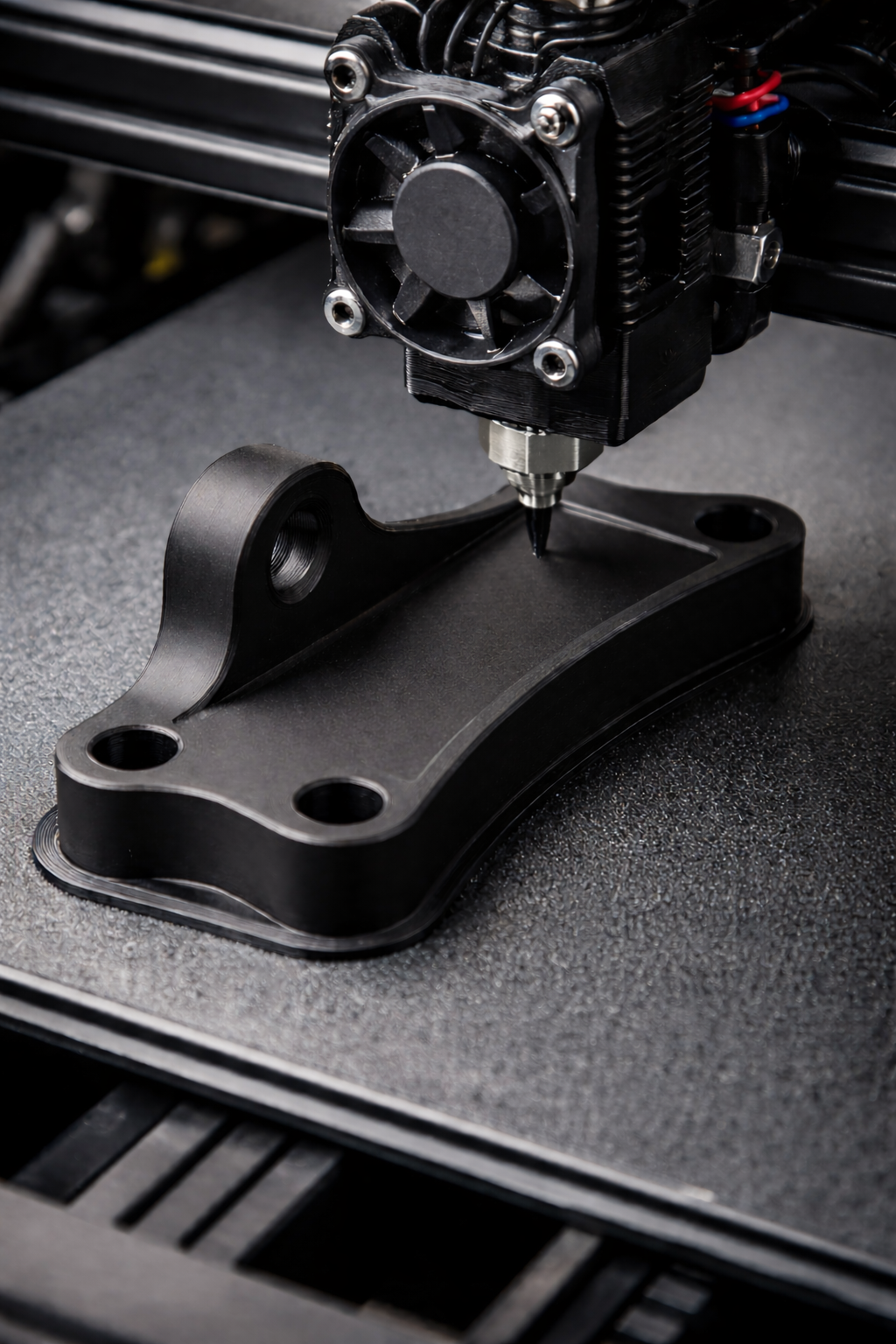
- Hardened steel or ruby nozzle (CF is abrasive)
Heated Bed:
- 90–120 °C recommended
Enclosure:
- Strongly recommended to reduce warping
2. Slicer Settings (Typical)
| Setting | Value |
|---|---|
| Nozzle Temp | 260–300 °C |
| Bed Temp | 90–110 °C |
| Print Speed | 30–50 mm/s |
| Retraction | Moderate |
| Fan | 0–20% |
These values vary by brand and printer. Always reference the filament manufacturer first.
3. Nozzle Selection
Carbon fiber is abrasive.
- Brass nozzles wear out fast
- Hardened steel or coated nozzles last longer
- Some people choose ruby-tipped nozzles for ultimate longevity.
4. Adhesion Tips
- PEI sheet works great
- Glue stick or PVA helps
- Brims and rafts improve first-layer success
Pros and Cons: Quick Summary
Pros
- High stiffness and strength
- Great heat resistance
- Excellent for functional parts
- Matte industrial finish
Cons
- Abrasive (wears nozzles)
- Requires high temps and sometimes enclosure
- Reduced impact resistance compared to pure PC
- More expensive than PLA / ABS
Yes, if you need performance.
It’s a premium filament for premium prints and not for casual hobby projects. If your goal is stronger, more thermally capable parts and your printer is up to the task, PC CF delivers real, measurable benefits.
For most hobbyists, the leap from PLA/ABS to PC CF is like going from a family sedan to a sports car, you don’t always need it, but you’ll see and feel the difference when performance matters.
Conclusion
PC CF filament is not just hype, it’s a proven, high-performance material that occupies a valuable niche between standard FDM filaments and high-end engineering polymers. With the right setup and expectations, it enables parts that are stiffer, stronger, and far more heat resistant than typical prints.
If you’re printing functional components, mechanical parts, or anything that must withstand real loads and environments, PC CF is definitely worth considering.